
Between a Rock (the U.S.) and a Hard Place (China)
Author: Matthew Shane
Published: Nov 8, 2025
Canada has historically been known as a nation of pleasers. In a world full of aggression and violence and trade wars and territorial spats, we have tended to play the role of peacekeeper, of medic, of cautious diplomat.
Sometimes this has required considerable restraint. But it’s also helped us become one of the most respected countries on the planet; a trusted ally, a friend other’s could count on.
And it's helped our economy as well – we’ve built free trade agreements with over 50 countries around the world (Govt of Canada), which has helped support our farms, export our natural resources, and keep our factories and mills humming.
My, the times they are a-changing.
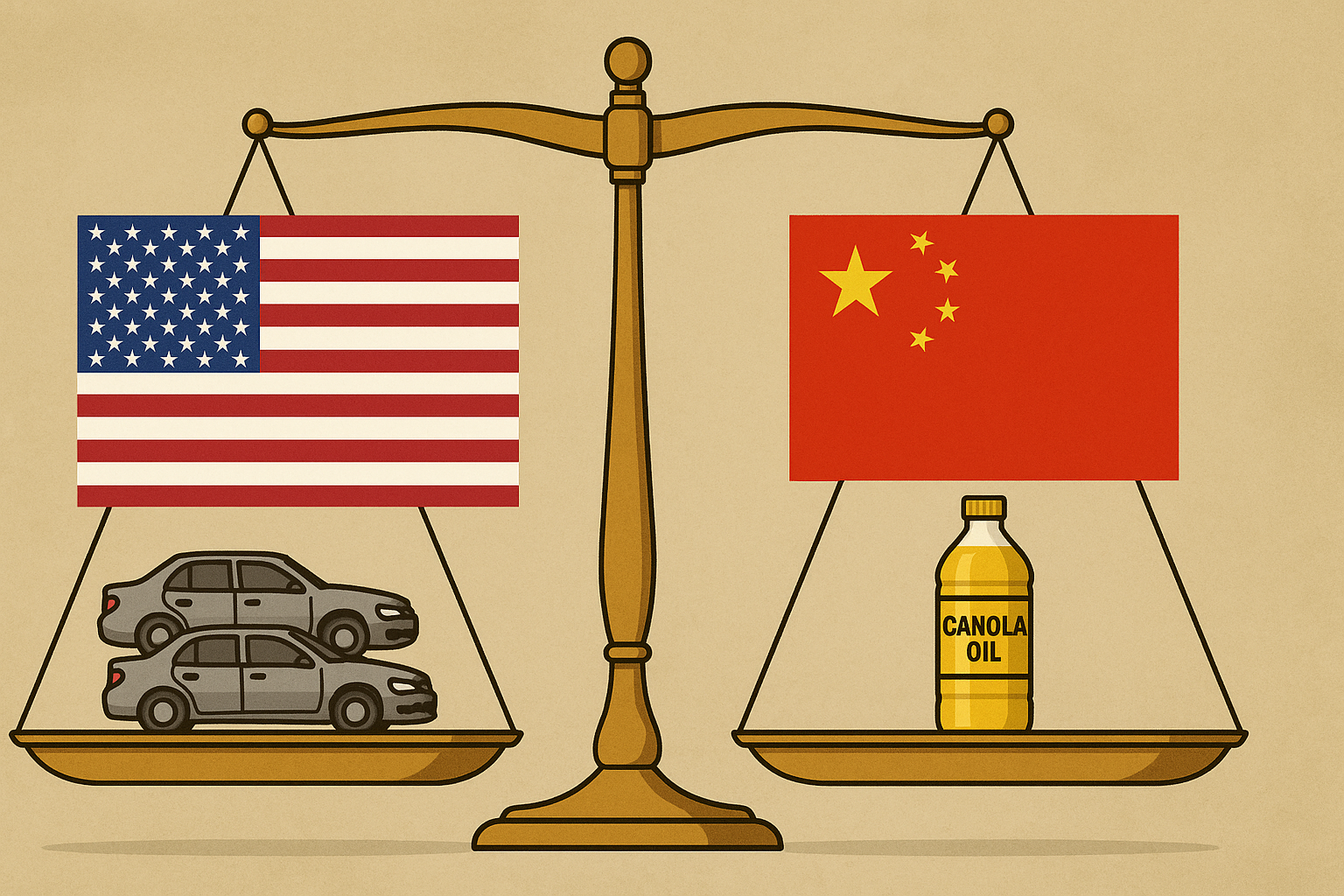
The U.S., obviously, continues to put the screws to us for reasons that Trump alone can understand. But now other nations are beginning to sense their opportunities. For instance, a couple of weeks ago, China made an extremely sly offer: if Canada removes their tariffs on Chinese electric vehicles (EVs), China will remove tariffs from canola oil (which, in case you didn’t know, is an important export commodity for the Prairies).
On the surface, this may seem a fair offer (and, at face value, it is). But to fully understand the slyness of this offer, some additional context is needed
The Backdrop
Back in 2024, the US raised its tariff on Chinese EVs from 25% to a seemingly excessive 100%, to ensure that these vehicles weren’t able to competitively enter the US marketplace. Following this, the US (and Canadian auto unions) ‘strongly encouraged’ that Canada follow suit – which we did. In fact, the tariff increase in Canada was even more substantive: from an original rate of 6.1%, to the same 100% tariff that the US had imposed. Ontario’s Premier Doug Ford, standing in front of a sea of blue-collar workers, claimed that 157,000 auto jobs were at stake (which was not as hyperbolic as it may have seemed at the time).
Perhaps predictably, China wasn’t so happy with this: within a couple of weeks, they announced a similarly excessive 100% tariff on Canadian canola oil and meal, followed by a 75.8% duty on canola seed. It’s unclear whether they were trying to protect their own economy, or (more likely) were simply firing back a tit-for-tat tariff to demonstrate their displeasure with Canada’s decision to side with the US. Either way, it hurt: a 100% tariff on canola oil essentially removed the ability to sell canola to China at all (for a profit, anyway).
So, when China came back to Canada last week and offered to drop its canola barriers, what it was essentially doing was testing Canada’s loyalty to the US. China is well aware that our relationship with the US is frayed; that Canadian consumers are avoiding US products like the plague; that Carney has explicitly indicated that he will be looking for new friends, new trading partners, in the years to come. And so they are poking into the sand, testing the waters, seeing just how far Canada is willing to go to protect their own interests.
A Rock, or a Hard Place?
Make no mistake, this puts Canada in a really awkward position. Should we remove the 100% tariff on Chinese EVs, even though it would go against the US’s explicit request to invoke them? Doing so would almost certainly risk U.S. retaliation (e.g. increased tariffs, additional threats to auto and metal exports, perhaps also lumber and paper products) by being viewed as Canada explicitly choosing to buddy up to China instead of the US. Or should we keep the tariffs, and our delicate allegiance with the US, in place, even though it would mean knowingly sacrificing the canola industry? Both options hold considerable risk; to some extent it may be a matter of choosing the devil you know over the one you don’t.
There’s another layer to this, however – an interprovincial one - that China probably isn’t inherently concerned about, but which ratchets up the pressure, nonetheless.
The auto industry is a major component of Ontario’s manufacturing backbone – Honda, Toyota, Ford, Stellantis, GM all have large manufacturing facilities that employ in excess of 100K workers, and further stimulate the downstream auto parts sector. So lowering the tariff on Chinese EVs will not only lead to increased tariffs on the auto sector by Trump, they’ll also be viewed very poorly by the multinationals that currently manufacture in Ontario.
The canola industry, in turn, is a major component of the Prairies’ economic backbone. Richardson International, Viterra, Cargill – these may not have the same name presence across the country, but they connect hundreds of thousands of Canadian jobs within the canola sector.
So, not only is Canada being forced to choose (quite publicly) between the US and China, it’s also being forced to choose (more implicitly) between Ontario and the Prairies. A rock versus a hard place, indeed.
Is there a viable solution?
There are no easy exits here, and probably no “best” outcomes either. The safest, most rational path – at least in the near term – is likely to keep the EV tariffs in place and maintain the status quo alignment with the US. Retooling trade relationships takes decades, and as much as Canadians may resent the dependence, it’s probably too early, and too risky, to fully pivot away from our southern neighbour. A U.S. backlash could cripple manufacturing and metals (and lumber, and water, and oil) in one Trumpian stroke. And so, for now, like it or not, the United States will almost certainly remain ‘our closest friend’.
Still, Canada cannot afford to wait passively in America’s shadow. We absolutely must push aggressively in developing new partnerships, and China is demonstrating that they’d appreciate front-of-the-line access. Moreover, the canola sector is bleeding, and a $43-billion industry cannot be left to wither for the sake of diplomatic decorum.
While we may not be able to touch tariffs on EVs; perhaps we could broker other trade/diplomatic arrangements, in other strategic industries, that can serve to begin the process of building trust with China, in a way that doesn’t quite so blatantly go against US interests. Energy, raw materials, or clean tech, for instance, are industries where Canada has significant negotiating power, and where China may appreciate some personalized treatment.
And while all of this plays out at the level of trade ministers and premiers, it’s worth remembering that policy isn’t the only lever. Consumers drive the economy. Every purchase is a choice that sends a signal. If we want a strong auto industry, we can buy cars built here in Canada. If we want to help Prairie farmers, we can pick canola oil made and owned by Canadian companies. These choices won’t change the world overnight, but they will add up to help quietly and consistently shape the economy we live in.
After writing this blog, I became aware of a YouTube channel called Dominion Report which recently developed a video on a very similar topic. If you liked the content above, perhaps worth checking it out:
Dominion Report: China, EVs & Tariffs
Liked this blog?
We are stronger together!
🤝 The strength of the Buy Canadian movement is in our collective purchasing power. So please share this blog with someone else who you feel would appreciate the message.
A few other posts you may be interested in: